
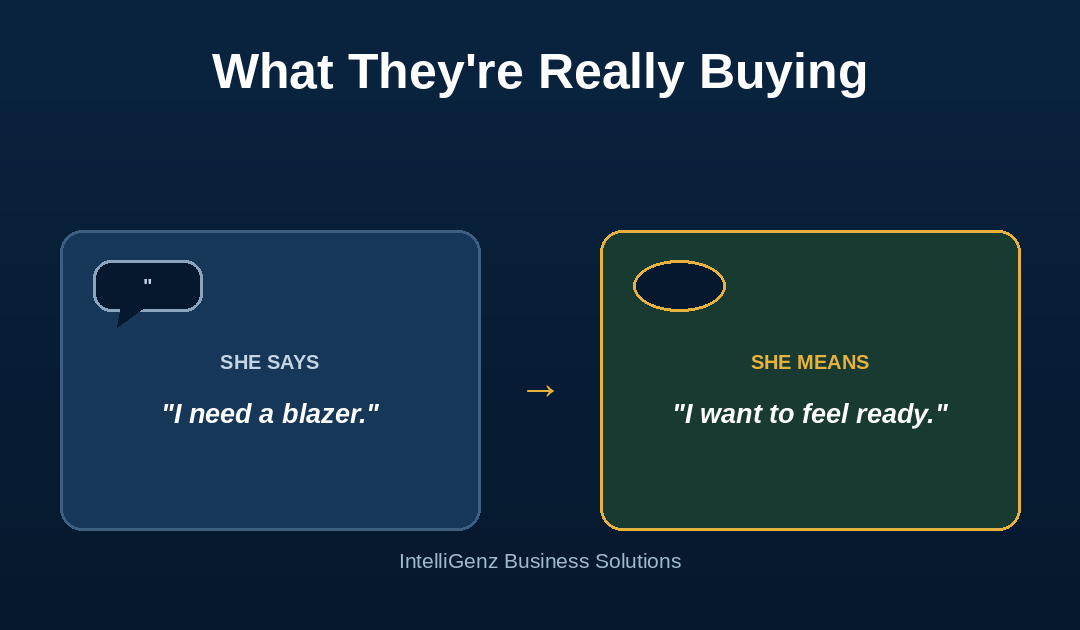
A woman walks into your shop on a Tuesday morning and says she needs something to wear to a job interview on Friday. Ask her what she wants and she’ll probably say “a blazer,” maybe “something professional.” But that’s not actually what she came in to buy.
What She’s Actually Buying
She doesn’t want a blazer. She wants to walk into that interview Friday morning and not think about her clothes once — she wants to feel like the most capable person in the room. The blazer is just the thing that gets her there. If you sell her on the blazer itself — the fabric, the cut, the price tag — you’re competing against every other blazer on a rack somewhere, including the one at a discount store for half the price. If you sell her on how she’s going to feel walking through that door, you’re barely competing with anyone.
The Three Layers Under Every Sale
Every purchase has three layers underneath it, and most small business owners only ever talk about the first one.
The External problem is the practical thing she says out loud — “I need a blazer,” “I need a part for my sink,” “I need a gift for my sister.” This almost never sets you apart, because any competitor can say the exact same sentence back to her.
The Internal problem is how she wants to feel once it’s solved — confident, polished, relieved, like she’s got this handled.
The Philosophical problem is the bigger thing underneath that — she wants to be the kind of person who shows up prepared, who takes her own next step seriously.
Your one-sentence pitch should come from that Internal or Philosophical layer, not the External one. Not “we sell interview-ready blazers,” but something closer to “we help you walk into the room like you already got the job.”
Try It On Your Own Shelves
Pick one thing you sell and ask what the customer is actually buying, one layer down. A hardware store customer paying $4 for a washer to fix a dripping faucet isn’t really buying a washer — he’s buying one less thing nagging at him over the weekend, plus the quiet satisfaction of fixing it himself instead of paying someone $150 to do it for him. That satisfaction is worth a lot more than $4, and it’s worth saying out loud — on a sign, in how you talk to him — instead of just ringing up the part.
Why This Is a Profit Question, Not Just a Marketing One
This isn’t only about what goes on your sign out front. A customer who’s buying a feeling isn’t comparison-shopping you against the big-box store three miles away on price alone — she’s already decided you’re the one who gets it, and she’ll pay for that. The clearer you are about what you’re actually selling underneath the product, the less of your business ends up competing purely on price. That’s the whole idea behind the Marketing Clarity piece of our Business Vitals Coaching℠ program.
If you want help finding your own one-sentence version of this — the thing underneath the thing you sell — that’s exactly the kind of work we dig into together in a Business Vitals Check℠. Let’s talk about what your customers are really walking in for.