
Picture this: you wake up with a fever you can’t shake, or your mother calls and you’re on a plane by dinner. Either way, you’re gone for a week — no laptop, no phone calls, nothing. By day two, is your business fine? Or is it starting to unravel?
For a lot of small business owners, the honest answer is somewhere between “uncomfortable” and “on fire.” Not because anyone did anything wrong. It’s because the business got built around you being there every single day, and nobody ever stopped to ask what happens when you’re not.
The Passwords Nobody Else Has
Start with the basics: who else can get into your POS system if it locks up? Your bank portal? QuickBooks? The wifi router, even? If the answer is “just me,” you’ve got a single point of failure sitting in your head — and heads get the flu.
The Vendor Who Only Talks to You
Every business has one: the supplier who won’t budge on a delivery without your personal okay, the landlord who has your cell number but not your manager’s. These relationships took years to build, which is exactly why they’re risky — there’s no backup plan, just you.
The Judgment Calls That Live in Your Head
Who covers a shift when someone calls in sick? What actually gets comped when a customer’s unhappy? What’s the real opening and closing routine, beyond “unlock the door”? None of this is written down anywhere, because you’ve never had to write it down — you’re always there to make the call.
The One Signature Everything Waits On
And then there’s the stuff that just… waits. Checks that need signing. Approvals that need your say-so. A vendor payment nobody else is authorized to release. If it all queues up behind you, a week away doesn’t just slow things down — it can stall the whole operation.
Try the Week-Off Test
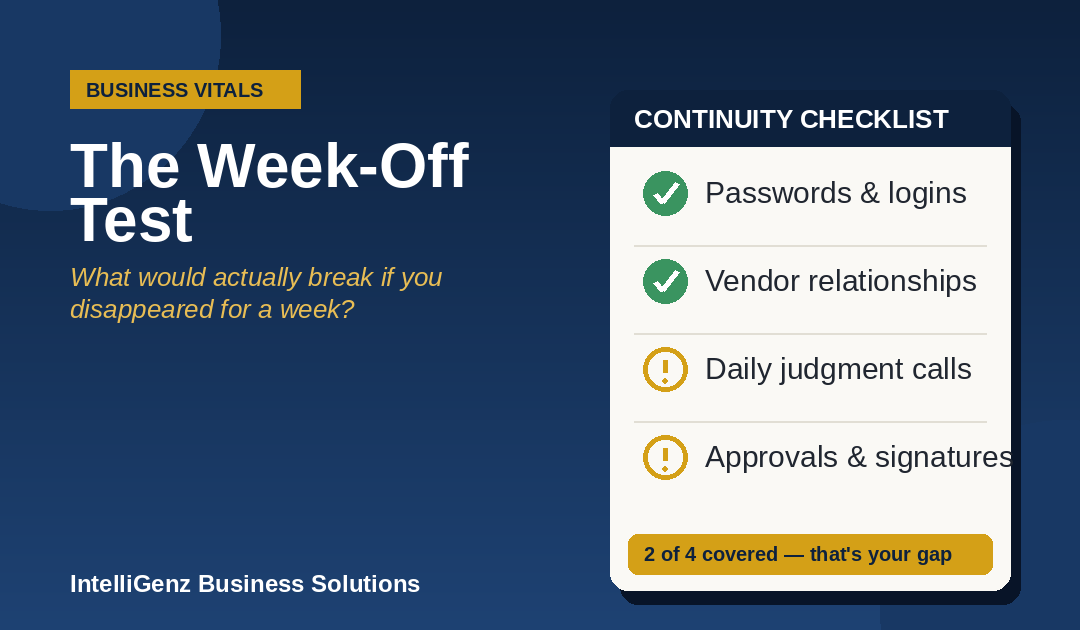
Here’s a simple exercise: pick a random Tuesday and write down everything that would grind to a halt if nobody could reach you for seven days. Passwords, vendor calls, daily decisions, signatures — the whole list. That list isn’t a to-do list. It’s your continuity gap, and it’s usually a lot shorter to close than owners expect. Sometimes it’s one shared password manager. Sometimes it’s training a manager on three decisions instead of thirty. Sometimes it’s just writing down the opening checklist that’s been living in your head for a decade.
The point isn’t to plan for disaster. It’s the difference between owning a business and being chained to one. A business that runs fine without you for a week is worth more — and it’s a lot less stressful to own.
If your week-off list is longer than you’d like, that’s exactly the kind of gap we help close in Business Vitals coaching — building the backups, checklists, and handoffs that let you actually step away. Let’s talk about closing yours.