
It’s Monday morning and you check your business bank balance: $18,340. Feels good, right? Then you remember Friday’s payroll is $6,200, next month’s sales tax remittance is a little over $2,100, and there’s a vendor bill due Wednesday. Suddenly that comfortable number is doing a lot of math in your head — and you’re not really sure how much of it you can spend.
If that sounds familiar, you don’t have a cash problem. You have a whose-money-is-this problem.
The old trick that still works
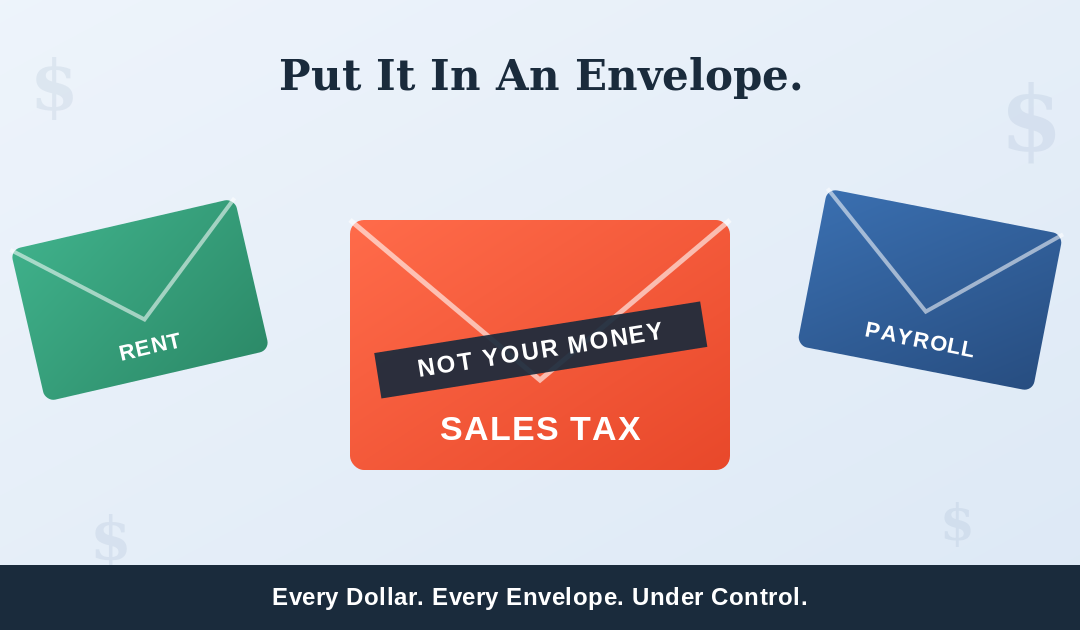
Long before software, business owners used cash envelopes — one for rent, one for payroll, one for taxes, one for “don’t touch this no matter what.” Every dollar had a job the moment it came in, so nothing got spent twice by accident. Intuit’s own guide to envelope budgeting walks through the classic version, and the principle hasn’t changed: money you haven’t labeled yet is money you’ll accidentally spend.
Your sales tax isn’t your money
Here’s the one envelope that matters more than the rest. When a customer pays $107 for a $100 item, that extra $7 was never yours. You collected it on behalf of the state, and you’re just holding it until it’s time to hand it over. It shows up in your checking account looking exactly like revenue — same account, same color, spends the same — but it isn’t. It’s someone else’s money sitting in your custody.
That’s exactly why so many retailers and restaurants get blindsided at filing time. The sales tax was never physically separated, so it quietly got absorbed into payroll or a big inventory order, and now there’s a gap where the remittance is supposed to be. The fix isn’t better willpower — it’s making that money physically impossible to spend by accident, the moment it comes in.
Relay: envelopes you can’t accidentally raid
This is where Relay comes in. Instead of one bank account holding everything, Relay gives you up to 20 real checking accounts — each with its own routing and account number — built around the Profit First method of splitting every dollar the moment it lands: one account for sales tax, one for payroll, one for operating expenses, one for profit.
You can set a rule that automatically sweeps a percentage of every deposit into your Sales Tax account the day it comes in, so by the time the state’s return is due, the money’s already sitting there, untouched, waiting. No spreadsheet, no year-end scramble, no “we’ll figure it out later.” It still syncs back to your books, so your accounting doesn’t skip a beat.
We’re set up as a Relay partner, so if you want to see it for yourself, you can open an account here and we’ll help you get the envelopes configured correctly from day one — sales tax first.
Start with one envelope
You don’t have to overhaul your whole banking setup this week. Start with the one that carries the most risk: open a separate account for sales tax and route it there automatically. Everything else can follow.
Knowing exactly how much to set aside — and building a real cash flow plan around it — is the part most owners get stuck on. That’s where we come in. If you’d like help setting up your envelopes the right way, let’s talk.