
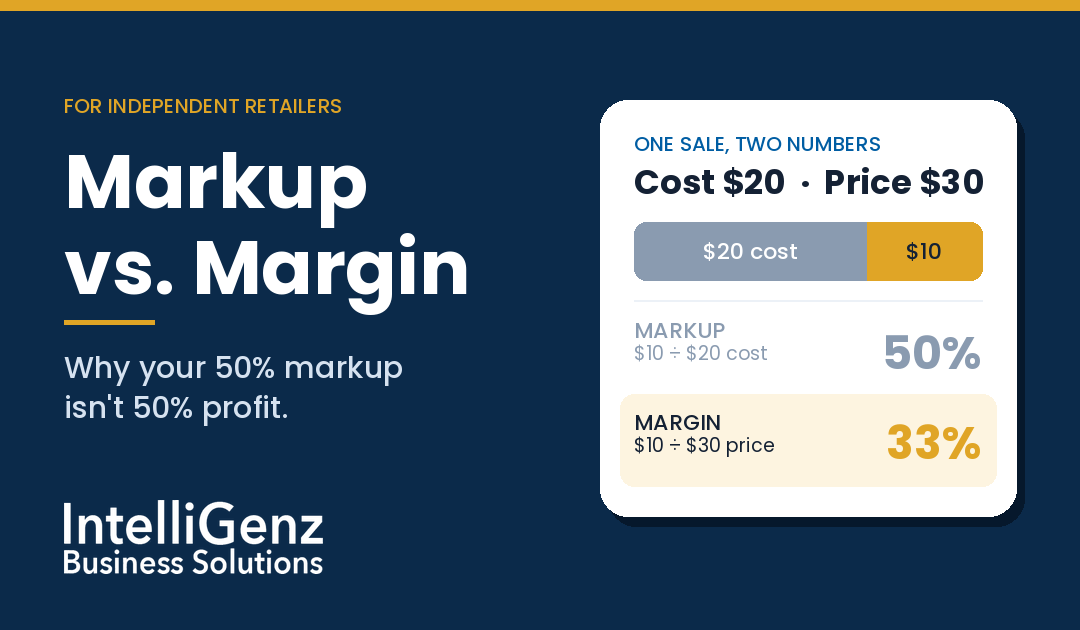
Say you buy a candle from your supplier for $20 and put it on the shelf for $30. Ask most shop owners what they’re making on it and you’ll hear “fifty percent.”
They’re right, sort of. That’s the markup. It isn’t the margin. The gap between those two numbers is where a lot of independent retailers lose money without ever seeing it happen.
The short version
- Markup is your profit divided by what the item cost you. Margin is your profit divided by what you sold it for. Same dollars, different math.
- A 50% markup is only a 33% margin. To get a 50% margin, you need a 100% markup.
- Rent, payroll and the light bill get paid out of margin, not markup. Plan with margin.
- With what everything costs today, we recommend pricing for at least a 50% margin.
- Discounts eat margin much faster than they look like they do.
Same $10, two very different percentages
Back to the candle. You make $10 on it.
- Markup: $10 ÷ $20 cost = 50%
- Margin: $10 ÷ $30 price = 33%
Neither number is wrong. They just answer different questions. Markup tells you how far above cost you priced something. Margin tells you how much of every sales dollar you actually get to keep to run the store.
That second one is the number your rent cares about.
Where the mix-up actually costs you
Let’s say your store does $400,000 a year in sales. Rent, payroll, utilities, card fees and insurance run about $120,000, or 30% of sales.
If you’re thinking “I mark everything up 50%, so half of every sale is mine,” the math in your head looks like this: $200,000 in gross profit, minus $120,000 in expenses, leaves about $80,000 for you.
Here’s what the books actually say. At a real 33% margin, gross profit is about $133,000. Take out the same $120,000 and you’re left with roughly $13,000. That’s the year.
Here’s the kicker: that $80,000 the owner had in mind is real, but only at a true 50% margin, which takes a 100% markup.
Same sales. Same busy December. A very different January. It’s not a sales problem. It’s a pricing math problem, and it’s one of the first things we look at in our profitability coaching.
Discounts: the margin hit nobody calculates
Now put that candle on a 20% off sale. The price drops from $30 to $24, and your profit drops from $10 to $4.
Your customer sees 20% off. You just gave up 60% of your profit on that sale. To make the same $10 you used to make on one candle, you’d have to sell two and a half of them.
I’m not saying never run a sale. Just know what it costs before the sign goes up.
How to price for the margin you actually need
Start with the margin you need and work backward to the price:
Price = Cost ÷ (1 − target margin)
Our recommendation: a 50% margin, minimum. Between rent, payroll, insurance, card fees and everything else that’s gone up, anything less leaves very little room to pay yourself. For that $20 candle, a 50% margin works out to $20 ÷ 0.50 = $40.
That’s not a number to make up per item. Some items will carry more and some less, but the store-wide average has to land at 50% or better. To see whether your store needs even more, add your operating expenses as a percent of sales to the profit you want to keep. If that adds up past 50%, price for that number instead. Once the margin is right, our E4B™ System makes sure that profit actually gets set aside instead of disappearing into next week’s order.
Quick conversion chart to keep by the register:
- 25% markup = 20% margin
- 50% markup = 33% margin
- 75% markup = 43% margin
- 100% markup = 50% margin
- 150% markup = 60% margin
Where to find this in your books
You don’t have to guess at your real margin. Two places to look in QuickBooks Online:
- Your Profit and Loss report. Divide Gross Profit by Total Income. Run it for the last 12 months. That’s your actual store-wide margin, after the discounts, markdowns and everything else, and it’s the number to compare against that 50% minimum.
- Sales by Product/Service Summary. If you track inventory items in QuickBooks, this report shows cost of goods sold, gross margin and gross margin % item by item. Per Intuit’s QuickBooks community, those margin columns only fill in for inventory items, so for anything else you’ll need to export the report and do the math in a spreadsheet.
If those margin columns come up empty, or the numbers just don’t look like your store, that’s usually a sign the books need some attention first. A QuickBooks cleanup gets them back to numbers you can actually price from.
Frequently asked questions
Is markup or margin better to use?
Both have their place. Markup is handy when you’re pricing straight off a supplier invoice. Margin is what you plan with, because your expenses are measured as a percent of sales too. The one thing to never do is compare a markup to an expense percentage.
How do I convert markup to margin?
Margin = markup ÷ (1 + markup). So a 50% markup is 0.50 ÷ 1.50 = 33%. To go the other way, markup = margin ÷ (1 − margin). A 50% margin takes a 100% markup.
What’s a good profit margin for a small retail store?
We recommend at least 50% to cover today’s expenses and still leave something for you. Higher-overhead stores may need more, so add your operating expenses as a percent of sales to the profit you want to keep and see where it lands. If the margin on your P&L comes in below 50%, pricing, product mix and discounting are the first places to look.
Why is my margin on the P&L lower than my pricing math says?
Because the price tag isn’t the whole story. Discounts, markdowns, shrink (theft and damage), freight costs you didn’t build into the price, and slow movers you finally clear out cheap all pull your real margin below what you thought you set.
Let’s find your real number
If you’ve been running on “I mark everything up 50%” and the bank account doesn’t agree, let’s talk. We’ll pull your real margin by category, figure out what your store actually needs to keep, and build your pricing, and your plan, around that. That’s where we come in.