
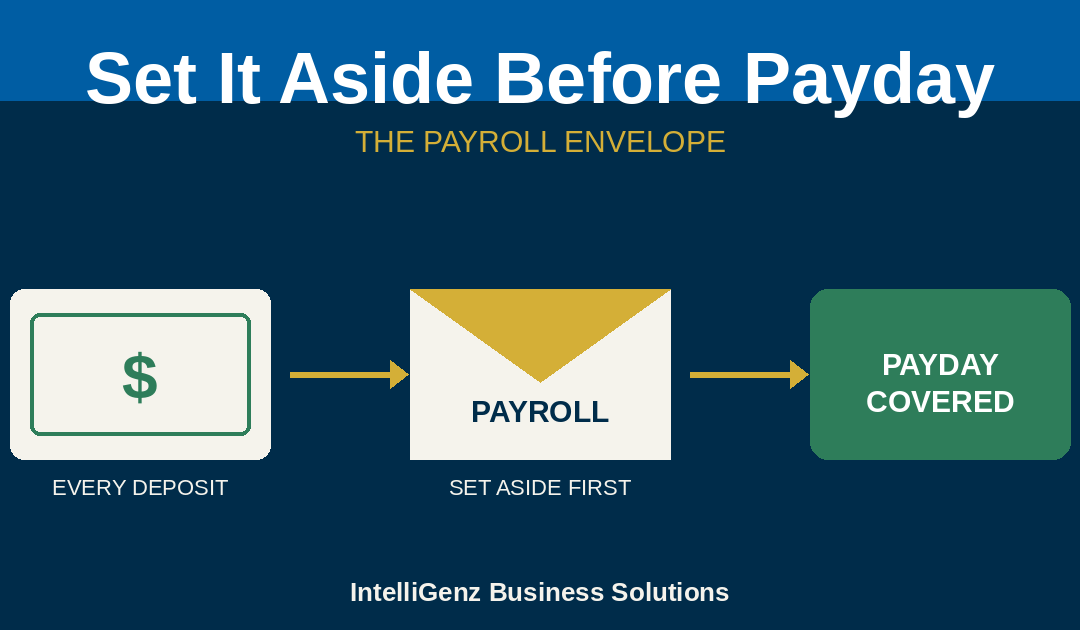
Thursday afternoon, the deposit from this week’s sales finally clears. The vendor invoice is due Friday. The food order showed up bigger than planned. And somewhere in the back of your mind, there’s payroll — due Monday, non-negotiable, and suddenly competing with everything else that wants a piece of that same deposit.
If you’ve ever moved money between accounts the night before payday hoping it clears in time, you’re not doing anything wrong. You’re just missing one piece: a payroll envelope.
What the Payroll Envelope Actually Does
The idea is simple, and it’s the same logic behind the income tax and profit envelopes we’ve talked about the last couple of weeks: the moment money comes in, a slice of it gets set aside for payroll — including the employer taxes that come with it — before it has a chance to get spent on anything else. Not after you’ve paid the vendors. Not “whatever’s left.” First.
That one change moves payroll from a decision you make under pressure every pay period to a number that’s already sitting there waiting, because you already decided.
Finding Your Real Number
There’s no single “right” percentage here — it depends on your labor model. Retailers often run payroll (with taxes) somewhere in the 15-20% of revenue range; restaurants, where labor is a bigger piece of the pie, often run closer to 25-30%+. Those are rough industry rules of thumb, not your number.
Your actual number is sitting in your own QuickBooks file. Pull your last three payroll runs (including the employer tax portion), add them up, and divide by the revenue from that same stretch. That’s your real payroll percentage — not an estimate, not a guess, the one your business actually runs on.
Set It Aside the Moment the Money Lands
Once you know your number, the mechanics are the same as any E4B™ envelope: every time a deposit hits, that percentage moves into a separate account (a free sub-account at your bank works fine) before it’s available to spend on anything else. By the time payday actually arrives, you’re not checking the balance and hoping — you’re just releasing money that’s already been set aside for exactly this.
It won’t feel like much the first few weeks. But the first time payroll lands on a tight week and you don’t even notice, that’s the envelope doing its job.
Where This Fits
This is the third envelope we’ve walked through — income tax, profit, and now payroll. Each one takes a number that used to live in your head (or worse, in a spreadsheet you update once a quarter) and turns it into something that happens automatically, every time money comes in.
If you’re not sure what your real payroll percentage is, or you want help setting up the actual envelopes rather than just reading about them, that’s exactly where we come in. Let’s talk about building out your E4B™ System.